

Ludi vs EasyRetro: Which Is Better for Agile Teams?
EasyRetro (formerly FunRetro) is a simple column-based retrospective board: columns, sticky notes, voting. It does one thing and does it quickly. Ludi is an online whiteboard for agile teams, covering retrospectives, sprint planning, estimation, team health checks, and workshops on a freeform visual canvas with built-in facilitation tools.
If your team only runs retros and wants the fastest, simplest tool possible, EasyRetro is good at that. If your team needs engaging templates, facilitation depth, action tracking, planning tools, or anything beyond simple columns, Ludi is built for exactly that.
Start your free 30-day trial — no credit card, no commitment.
What is Ludi?
Ludi is an online whiteboard for agile teams. It’s a collaborative visual canvas built specifically for agile ceremonies: retrospectives, sprint planning, estimation, team health checks, brainstorming, and workshops.
What is EasyRetro?
EasyRetro (formerly FunRetro) is a simple column-based retrospective board. You create columns, participants add cards, vote on them, and discuss. It’s been around since 2015, built by a small bootstrapped team in Brazil, and it’s earned its place as one of the most well-known standalone retro tools.
Ludi vs EasyRetro: At a Glance
| Ludi | EasyRetro | |
|---|---|---|
| Built for | All agile ceremonies | Retrospectives only |
| Team type | Engineering and product teams | Teams wanting the simplest retro tool |
| Format | Whiteboard | Fixed columns and card |
| Starting price | $4/member/month | $21/month/team |
| Pricing model | Per team member | Team pricing |
| 30-day free trial | ||
| Free plan | ||
| Retro templates | 60+ | |
| Sprint planning templates | ||
| Planning poker / estimation | ||
| Team health check templates | ||
| Workshop and brainstorming templates | ||
| Private writing | ||
| Topic grouping | ||
| Team voting | ||
| Activity Frames (host-controlled phase visibility) | ||
| Readiness checks | ||
| Individual reveal of stickies | ||
| Action creation | ||
| Action assignees and due dates | ||
| Action reminders | ||
| Action carry-forward to next board | ||
| Send actions to Jira | ||
| Full two-way Jira integration | ||
| AI features | sticky grouping | meeting summary |
| Engagement features (icebreakers, confetti, gadgets) | ||
| Multi-language UI | 7 languages | |
| SAML SSO | Business plan, $6/member/month | Enterprise 15 only, £204/month min |
| Guest participants |
When to Choose Ludi vs EasyRetro
When to choose Ludi
- You want meetings people actually enjoy — icebreakers, engagement features, and a visual canvas that makes remote sessions feel collaborative instead of procedural
- You’ve outgrown EasyRetro — you started with columns, now you need a canvas, facilitation depth, and action tracking that actually follows through
- You’re a Scrum Master who runs meetings regularly and wants control over visibility and pacing, not just a canvas to dump stickies on
- Your team does more than retros — sprint planning, estimation, health checks, workshops, story mapping all happen in one tool
- You need Jira integration — deep two-way sync for planning and estimation, not just one-way export
When to choose EasyRetro
- You only need retros and want the simplest possible tool — columns, cards, voting, done
- You want flat-fee, predictable pricing — EasyRetro cost is fixed per tier. The trade-off is the tier jumps when you outgrow a plan limit (more teams, more public boards).
- You want a free tier to demo with — EasyRetro’s free plan covers 1 board per month, enough to try the product but not to run a team on
- Your team isn’t English-speaking — 7 languages supported vs Ludi’s English-only
Key Differences
If you’re evaluating EasyRetro against Ludi as an alternative, these are the differences that matter most:
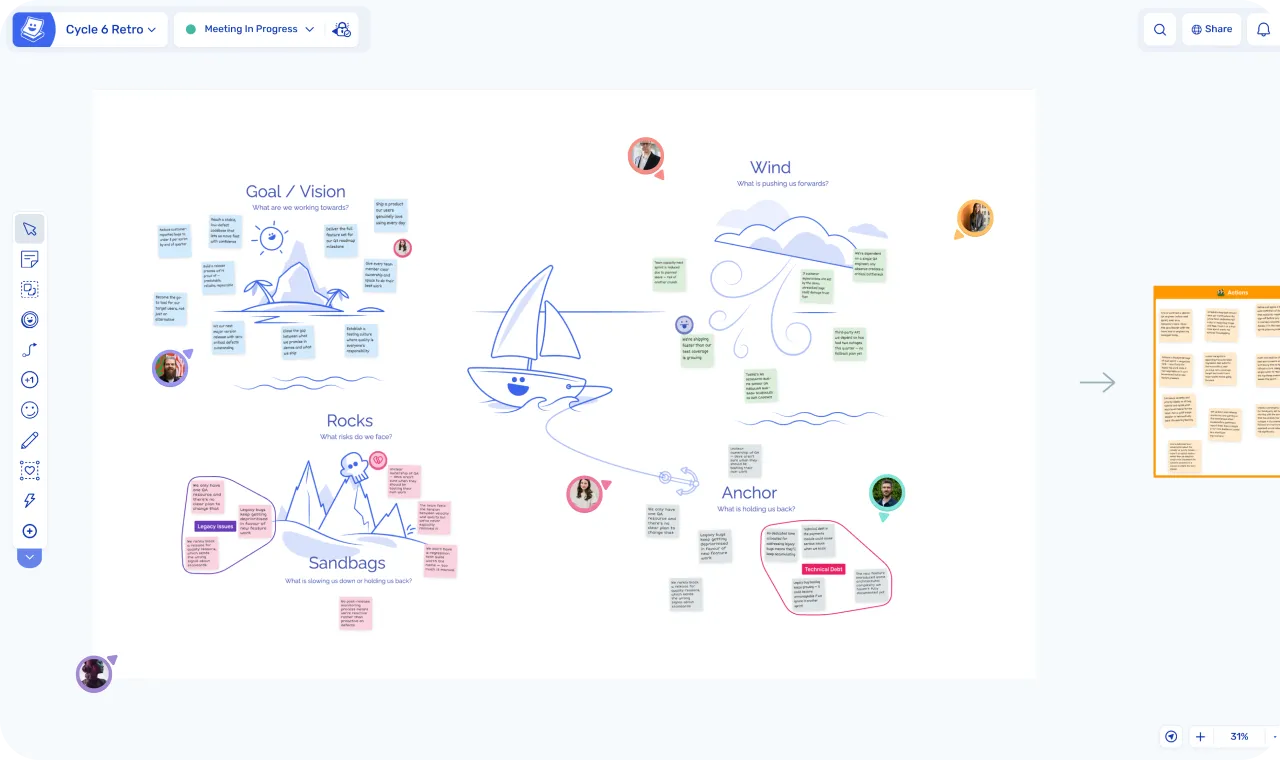
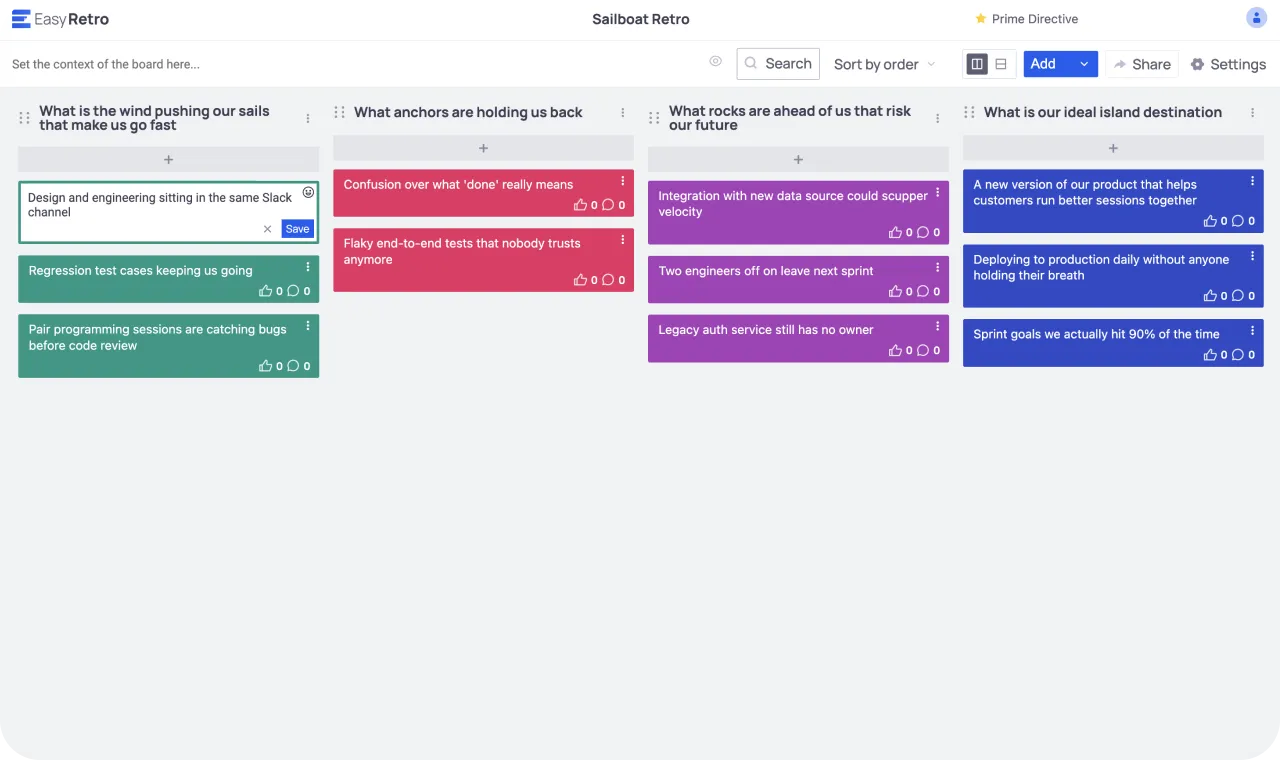
- Columns vs whiteboard canvas. EasyRetro is a column-based card board — think Trello for retros. Ludi is a freeform visual canvas with stickies, zones, shapes, drawing, and spatial layout. You can still run a column-based retro in Ludi, but you also get everything else a canvas makes possible.
- Retros only vs full ceremony coverage. EasyRetro does retrospectives. Ludi does retrospectives, sprint planning, backlog estimation, team health checks, brainstorming, story mapping, and workshops, each with templates and tooling built for the ceremony.
- Basic controls vs deep facilitation. EasyRetro has anonymous writing, voting, and a timer. Ludi has that plus pointers, readiness checks, co-hosts, content locking, activity frames, private writing with individual reveal, and attention management.
- Action items vs action tracking. In EasyRetro, you mark a card as an action. In Ludi, actions have assignees, due dates, email reminders, a tracking dashboard, and carry forward into the next meeting automatically.
- One-way Jira export vs two-way Jira sync. EasyRetro can push action items to Jira. Ludi pushes and pulls from Jira with a deep integration.
- Flat-fee vs per-seat pricing. EasyRetro charges a flat monthly fee per account; Ludi charges per member. For a team of 5, the cost is similar (Ludi $20/month, EasyRetro $21/month). At 10+ internal members EasyRetro is cheaper on headline cost. The caveat is SSO: it’s only on EasyRetro’s Enterprise 15 tier (£204/month), so any small or mid-sized team that needs SSO for compliance ends up paying significantly more on EasyRetro than on Ludi.
- One tool for one job vs one tool for the agile workflow. EasyRetro does retros only. For other collaborative sessions like sprint planning, estimation, team health checks, and workshops, you’ll be buying separate tools. Ludi covers all of those on one subscription, so the like-for-like comparison isn’t EasyRetro’s price vs Ludi’s — it’s EasyRetro plus your other tools vs Ludi alone.
Feature Comparison
Facilitation Features
EasyRetro has the basics: anonymous card writing, dot voting, a timer, and the ability to hide columns from participants. These cover a simple retro flow.
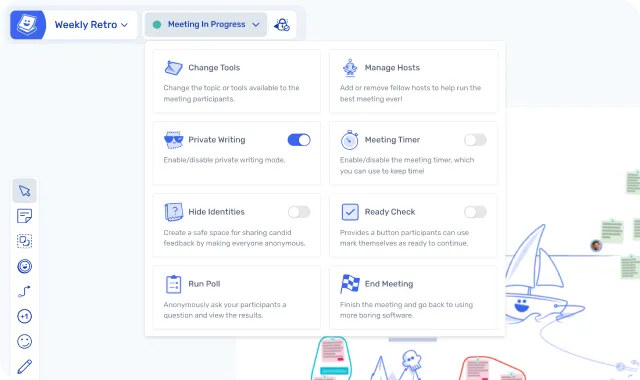
Ludi’s facilitation runs deeper. The host controls the meeting through Activity Frames — designated board sections that can be hidden, revealed, and jumped to. The facilitator decides which frames are visible, herds participants to the current one, and sets the pace through each phase (write privately, reveal together, group, vote, discuss, assign actions). Readiness checks show who’s finished writing before the group moves on. Content locking prevents edits mid-discussion. Co-hosts can share facilitation duties. Private writing has individual reveal and force reveal options. Anonymity is a proper toggle, not just “cards don’t show names.”
Bottom line: EasyRetro’s facilitation covers a basic retro. Ludi’s gives the facilitator control over visibility and navigation through each phase — so they can focus on the conversation, not the mechanics.
”Ludi has the best tools for the facilitator, it’s better than Miro, for instance. When you invite customers to your Ludi board, you don’t have to explain how to use Ludi, it is much simpler.”
— Aline Sillet, Agile Coach, XITASO
Templates
EasyRetro has retro templates — Start/Stop/Continue, Mad/Sad/Glad, 4Ls, Sailboat, and similar formats. Ultimately they’re all column presets: same structure, different headings.
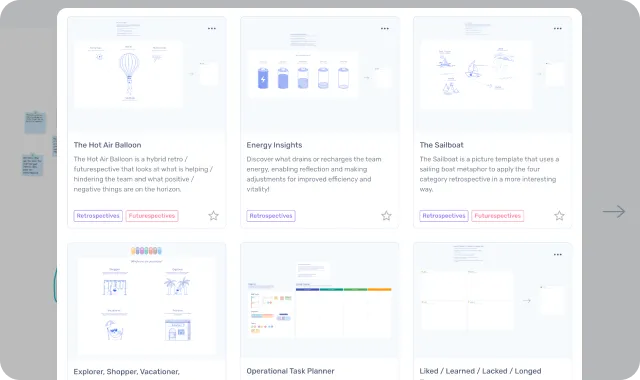
Ludi has 125+ templates across multiple ceremony types — retrospectives, sprint planning, estimation, team health checks, brainstorming, story mapping, and workshops. Every template is designed to work with the facilitation tools (Activity Frames, voting rounds, action tracking). Unique illustrated templates are designed as scenes, rather than fixed columns. Teams can save custom templates to a shared Team Template Library.
The breadth matters because agile teams don’t just run retros. If you need sprint planning next week, a team health check next month, and an estimation session tomorrow, EasyRetro can’t help with any of those. You’d need a separate tool — or you’d need a tool like Ludi that covers the lot.
”Ludi templates have been a lifesaver — a team can just pull up a template, read the instructions, and get going.”
— Samantha Corbett, Meltwater
Action Tracking
This is where a lot of teams hit the ceiling with EasyRetro.
In EasyRetro, you can mark a card as an action item. That’s it. No assignee, no due date, no reminder, no follow-up. The action lives on the board, and unless someone manually checks back next sprint, it’s forgotten.
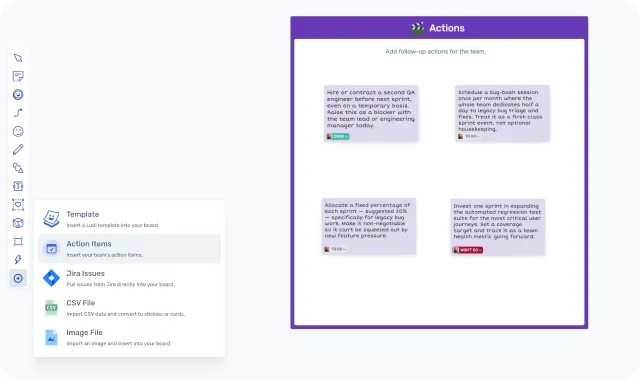
In Ludi, any sticky note can become an action item with an assignee, due date, status, and automated email reminders. There’s a dedicated action dashboard for batch management. Most importantly, actions carry forward into the next meeting board automatically — so the team reviews what they committed to last time before starting a new retro.
If your retros regularly produce action items that nobody follows up on, this is the feature that changes that.
Integrations
EasyRetro added bulk Jira export in 2025 — you can export action items to Jira Cloud in bulk. It’s one-way: cards go out, nothing comes back. There’s no backlog import, no estimation on the board, no sync. EasyRetro also supports export to Trello, Confluence, and Slack.
Ludi’s Jira integration is two-way. Pull backlog items onto the board, estimate collaboratively using planning poker or T-shirt sizing, create new issues from sticky notes, and sync story points and field changes back to Jira automatically.
If your team uses Jira for sprint planning, Ludi’s integration means the entire planning session (discussion, estimation, and Jira updates) happens in one place. With EasyRetro, Jira integration is limited to pushing retro actions out.
Jira Cloud is supported, talk to us if you use self-hosted Jira Data Centre.
Engagement
EasyRetro doesn’t have engagement features. It’s a functional tool — open, write, vote, discuss, close.
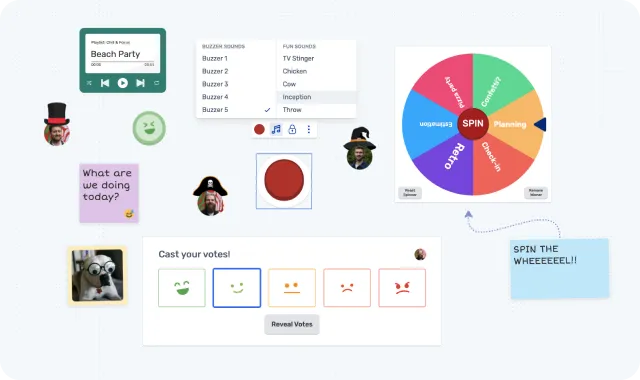
Ludi has icebreakers, confetti, virtual hats, a jukebox, spinner, buzzer, counters, and object trays. They’re a deliberate answer to the flatness of remote ceremonies, and often what gets quieter team members involved. When your team has been in meetings all day, the difference between “open a column board” and “open a board with an icebreaker already loaded” shows up in how people show up.
”Doing a retro in a column format feels like jail to me.”
— Florent, Agile Coach
”Ludi makes workshops, plannings & retros easy and fun!”
— Natalia Quintana, Xmartlabs
UX / Ease of Use
EasyRetro is deliberately minimal — almost no learning curve. Open a board, add some columns, invite your team. Done. That simplicity is its strongest feature, and it’s why teams keep choosing it for basic retros.
Ludi is more capable, but critically not more complicated for participants. Double-click to create a sticky note. That’s the core interaction. No looking around for the sticky note tool. Zones auto-colour stickies, so boards are visually consistent without anyone thinking about it. The complexity lives on the facilitator’s side. Participants just write, vote, and discuss. Ludi is designed so the ten people who show up have a frictionless experience, even if they’ve never seen it before.
”Adoption was the same for Ludi across the company — it was so fast. It took like 30 seconds for people to be autonomous on it.”
— Alex Imbeaux, Head of Talent Management Products, Lucca
Use Case Comparison
Retrospectives
Both tools run retros. EasyRetro uses a column-based layout — you create columns (typically 3-4), participants add cards, vote, and discuss. It’s structured, predictable, easy to understand, and has zero learning curve.
Ludi does that too. Pick a Start/Stop/Continue template, a Mad/Sad/Glad, or a 4Ls, and your team gets a structured retro with private writing, voting, grouping, and actions. You’re not giving up that workflow by choosing Ludi.
What you gain is the canvas underneath. In EasyRetro, customisation is limited to changing a column title, maybe a colour, a background image. In Ludi, you can change the layout, the zones, the colours, the shapes, the images, the entire visual structure. A “Sailboat” template in EasyRetro is columns labelled Wind, Anchor, Rocks, Island. In Ludi, it’s an actual visual sailboat on a canvas where the spatial metaphor helps the team think differently about what’s driving them forward and what’s holding them back. Participants can visually drag, group, and connect stickies together.
What Columns Can and Can’t Do
Here’s the thing about a column-based format: it works, but it also constrains.
When you give people three columns (What Went Well, What to Improve, Action Items), they’ll write short statements that fit those headings. That’s the format doing its job. But it’s also the format setting a ceiling on what gets contributed.
Retrospectives are supposed to surface the things teams don’t normally talk about. That requires different prompts, different frames, different ways of thinking about the same sprint. A sailboat retro isn’t just columns with nautical labels — on a visual canvas, the spatial metaphor genuinely changes how people approach the question. A timeline-based retro invites people to map the sprint as a story. A health check asks people to score how they feel, not just what they think.
Columns can’t do any of that. A card in a column is a card in a column, regardless of the heading. The format doesn’t invite exploration, lateral thinking, or expression beyond a single line of text. And when the format is limited, the contributions are limited — which means the discussion is limited, which means the actions coming out of it are limited.
This matters more than it sounds. The teams that get the most out of their retrospectives aren’t the ones with the best voting system — they’re the ones where the format itself draws out richer, more honest contributions. That’s what a visual canvas with varied templates, spatial grouping, and engagement features is designed to do.
”Almost all solutions I’ve reviewed, they are more like a Kanban board. You add tickets, goes straight into a fix column. Creative boards? Can’t. It’s just columns with +/- basically.”
— Florent de Luca, Agile Coach (reviewed 10+ competitors before choosing Ludi)
For teams running basic retros with no facilitation needs, EasyRetro works. For teams that want their retros to drive real improvement, with structured facilitation, honest contributions via visual prompts and private writing, and actions that get followed up, Ludi is the better EasyRetro alternative.
Sprint Planning and Estimation
EasyRetro cannot do sprint planning or estimation. It’s a retrospective board — there are no planning poker templates, no story point estimation, no backlog import, no capacity planning. If your team needs to estimate and plan sprints, you need a separate tool.
Ludi has dedicated sprint planning and estimation templates with automated planning poker (Fibonacci and T-shirt sizing). On the Business plan, the Jira integration pulls backlog items onto the board, the team estimates collaboratively, and story points sync back to Jira automatically. The entire planning session (discussion, estimation, and Jira updates) happens in one place.
Team Health Checks
EasyRetro has no team health check functionality. You could hack together columns labelled with health check categories, but there’s no structured exercise, no scoring, no trend tracking.
Ludi has dedicated team health check templates: structured exercises where team members rate different aspects of their work (delivery pace, team spirit, learning, etc.) and discuss the results. It’s a proper facilitated exercise, not a column workaround.
Workshops and Brainstorming
EasyRetro is a retro tool. You can use it for simple brainstorming by renaming columns, but it wasn’t designed for workshops, story mapping, roadmapping, or any other collaborative exercise.
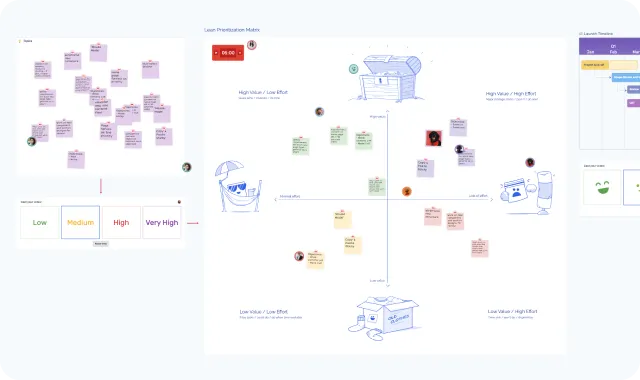
Ludi’s freeform canvas supports all of these. Story mapping templates, Lean Canvas, Crazy 8’s, roadmap timelines, and dozens of workshop formats are available out of the box. If your team runs any kind of collaborative session beyond retrospectives, EasyRetro simply doesn’t cover it.
Pricing
EasyRetro charges per account with a flat fee. Ludi charges per seat. For internal-team retros at scale, EasyRetro wins on headline cost.
| Plan | Price (annual billing) | Public boards/month | Teams | Members per team | SAML SSO |
|---|---|---|---|---|---|
| Free | $0 | 1 | 0 | — | |
| Team | $21/month | 5 | 1 | Unlimited | |
| Business | $50/month | 15 | 3 | Unlimited | |
| Large Business | $75/month | 30 | 6 | Unlimited | |
| Enterprise 15 | £204/month | 75 | 15 | Unlimited | |
| Enterprise Ultd | £453/month | Unlimited | Unlimited | Unlimited |
A few things the table doesn’t make obvious:
- Every paid plan includes unlimited internal team boards. The monthly cap is on public boards — link-shareable boards anyone can join without an account.
- For a Scrum Master running retros and planning with their own team, the public-board cap doesn’t bite. The cap matters for agile coaches and consultants who run sessions for external participants, or for cross-org workshops with attendees outside your account.
Cost for internal team use
| Team size | Ludi Starter ($4/member) | EasyRetro Team (flat $21) |
|---|---|---|
| 5 members | $20/month | $21/month |
| 10 members | $40/month | $21/month |
| 20 members | $80/month | $60/month (3 teams) |
EasyRetro is cheaper on headline cost for any team larger than about 6 people, as long as you’re running retros only and inviting external attendees rarely.
When the public-board cap matters
The 5 / 15 / 30 / 75 monthly cap is meaningful if:
- You’re an agile coach or consultant running retros for multiple client teams via shared links
- You run cross-org workshops with attendees who don’t have EasyRetro accounts
- You frequently invite external participants to one-off facilitated sessions
For internal product or engineering team use, you’ll rarely touch it.
SSO
EasyRetro’s SAML SSO is gated to Enterprise 15 (£204/month, ~$255) and above. It isn’t available on Free, Team, Business, or Large Business. A team that needs SSO for compliance jumps from $75/month (Large Business) straight to ~$255/month (Enterprise 15) — there’s no middle tier.
Ludi includes SSO on the Business plan at $6/member/month. For a small or mid-sized team that needs SSO, Ludi is cheaper. For 40+ members, EasyRetro’s flat Enterprise 15 fee starts to win on headline cost. Either way, the gap on EasyRetro is in availability rather than price: SSO is reserved for an enterprise contract that takes 1–2 weeks to provision per their help docs. Ludi is self-serve.
The honest take
EasyRetro is cheaper than Ludi on headline cost for internal-team use once you’re past about six people. Most teams looking for an EasyRetro alternative aren’t switching for price. They’re switching because they’ve outgrown what a column-based retro board can do. Ludi’s per-seat cost buys more capability across the board: more engaging and effective retrospectives, every agile ceremony, deeper facilitation, real action tracking, two-way Jira sync, and interactive features that change how meetings feel. Headline cost matters; what you can actually do with the tool matters more.
What Customers Say
Teams that have moved from column-based retro tools to Ludi tend to describe the difference in terms of depth and engagement — EasyRetro gets the job done, but Ludi changes how the meeting feels.
Baptiste Grand, Agile Coach, XITASO
“Most of the other tools out there were either bland three-column templates or huge whiteboard monsters. Ludi was exactly what we needed.”
Oleksandra Serebrianska, EPAM Systems
“Ludi is simple, engaging, and helps people open up and reflect honestly.”
Bertrand Potier, FIS Global
“Ludi’s focused list of features combined with ease of use is a major differentiator.”
Tim Gaye, Senior Software Engineering Manager, Kaluza
“Using Ludi is sort of taking the tool out of the equation and you can actually focus on having a retro. Previously I felt like half the time we were talking about the actual tool.”
“As with all busy teams, we don’t have a lot of spare time. I know that if I haven’t had time to prepare a retro, there will be a ready-made exercise in Ludi that I can use with the team.”
Switching from EasyRetro
How to switch from EasyRetro to Ludi
If you’re currently running retros in EasyRetro and want to try Ludi:
- Start with a retro. Pick a template you’d normally run in EasyRetro — a Sailboat or 4Ls — and see the difference a visual canvas with facilitator-controlled Activity Frames makes.
- No data migration needed. You’re not moving boards — you’re starting fresh sessions in a tool built for more than columns.
- Your team picks it up immediately. Double-click to add a sticky note. That’s the learning curve. If they could use EasyRetro, they can use Ludi.
- Then try something EasyRetro can’t do. Run a sprint planning session with Jira sync, or a team health check. That’s when the upgrade from a simple retro board to an online whiteboard for agile teams becomes obvious.
”Adoption was the same across the company — it was so fast. It took like 30 seconds for people to be autonomous on it. You usually experience friction when switching people to a new product, but we had none of that with Ludi.”
— Alex Imbeaux, Head of Talent Management Products, Lucca
”Three out of the 10 people in a meeting had literally never seen Ludi before. I didn’t really have to tell them anything about it. They just started using it.”
— Tim Gaye, Senior Software Engineering Manager, Kaluza
Final Verdict
EasyRetro is a good tool for what it does: simple, fast, focused retros with flat-fee pricing that’s cheaper than Ludi for internal teams above ~6 members. If your team only runs retrospectives, it works. But it’s a column-based retro board, and that’s all it will ever be. Ludi is the better alternative to EasyRetro for teams that need facilitation depth, action tracking that actually follows through, engagement features that change how meetings feel, and coverage across the full range of agile ceremonies (retros, sprint planning, estimation, health checks, and workshops) on one platform.
Start your free 30-day trial — no credit card, no commitment
Frequently asked questions
Last updated: April 2026. Public pricing verified against easyretro.io/pricing and in-app subscription flow. SSO availability and provisioning timeline verified against EasyRetro’s help docs.