

Ludi vs TeamRetro: Which Is Better for Agile Teams?
TeamRetro is a structured agile meeting tool — guided step-by-step flows for retrospectives, health checks, estimation meetings, and maturity model assessments. Ludi is an online whiteboard for agile teams — a visual canvas with built-in facilitation for retros, sprint planning, estimation, health checks, and workshops. They solve the same problem with fundamentally different approaches.
If you’re looking for a TeamRetro alternative that covers more meeting types than retros, health checks, and estimation, and makes remote sessions something your team enjoys — Ludi is worth trying.
What is Ludi?
Ludi is an online whiteboard for agile teams — a visual canvas purpose-built for retrospectives, sprint planning, backlog estimation, team health checks, and any other kind of workshop.
What is TeamRetro?
TeamRetro is an agile meeting tool with guided step-by-step flows for retrospectives, team health checks, and estimation meetings.
Ludi vs TeamRetro: See the Difference
| Ludi | TeamRetro | |
|---|---|---|
| Category | Online whiteboard for agile teams | Structured agile meeting tool |
| Built for | Retros, sprint planning, estimation, health checks, workshops | Retros, health checks, estimation meetings, maturity models |
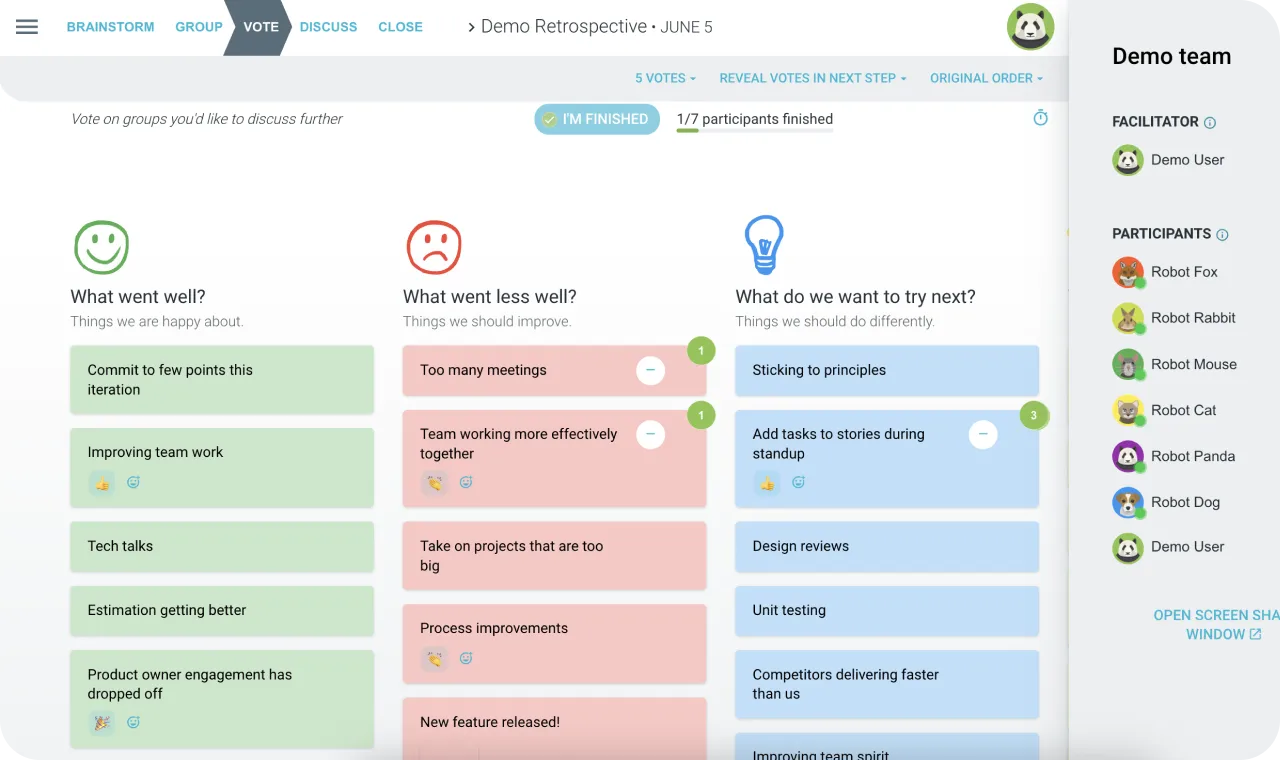
| Format | Freeform whiteboard canvas | Columns and cards |
| Custom board design | Decorate, draw, add images, build any layout | Structured templates + prebuilt framework drawings (RACI, SWOT, 5 Whys) |
| Templates | 125+ visual activities across ceremony types | 200+ retro, health check, and estimation templates |
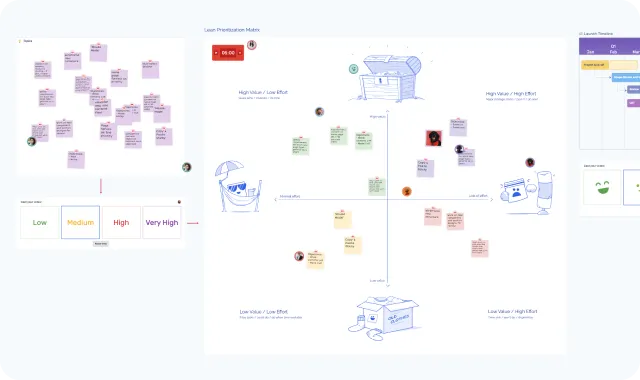
| Sprint planning | Visual planning on the canvas + two-way Jira sync | Planning poker only |
| Workshops & brainstorming | ||
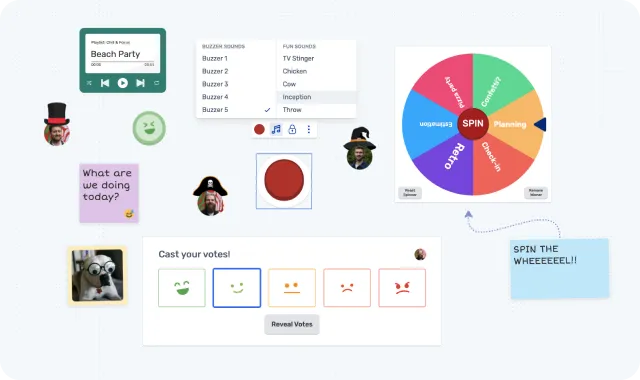
| Engagement features | Jukebox, hats, confetti, reactions, spinner, buzzer, unique handwriting | Limited — Kudos, GIFs (Tenor), emoji on stickies |
| AI features | AI sticky grouping | AI in 9 feature areas |
| MCP support | Coming Soon | Early access |
| Anonymous contributions | ||
| Action tracking | ||
| Health checks | Customisable health check templates | 14 prebuilt models + 21 maturity models with trend tracking |
| GDPR compliant | EU Hosted | |
| SOC 2 Type 2 | ||
| Pricing model | Per seat | Per team |
| Starting price | $4/member/month | $20.83/team/month (billed annually) |
| Free trial | 30-day free trial | 30-day free trial |
The Short Version
If your team runs retros, health checks, and estimation meetings — and you want straightforward per-team pricing with AI features throughout the workflow — TeamRetro does the job well.
Ludi is a different category of tool. It’s a whiteboard your facilitator and team can shape — pick a Mad/Sad/Glad template and you get a structured column-based retro, exactly like TeamRetro. But the same board can also host any retro design, a sprint planning session pulling live from Jira, a workshop with multiple activities, or a brainstorm that doesn’t fit any template at all. The canvas is the point.
The other point is energy. Ludi has a jukebox, confetti, virtual hats, emoji reactions, unique handwriting per person, and interactive gadgets that make remote sessions feel less like a chore. Teams that enjoy a tool participate more. That’s the difference between a retro that surfaces real issues and one where two people are involved and everyone else watches.
”Most of the other tools out there were either bland three-column templates or huge whiteboard monsters. Ludi was exactly what we needed.”
— Baptiste Grand, Agile Coach, XITASO
Key Differences
Collaborative Whiteboard
TeamRetro has a whiteboard feature inside meetings. So simple collaborative drawings can be made inside meetings with prebuilt framework templates. Useful for a quick sketch, but not a canvas you can build an entire session on. The whiteboards live inside the structured meeting flow, you can’t design the meeting itself around them.
Ludi is a full realtime whiteboard. The same canvas that runs a three-column retro can also host:
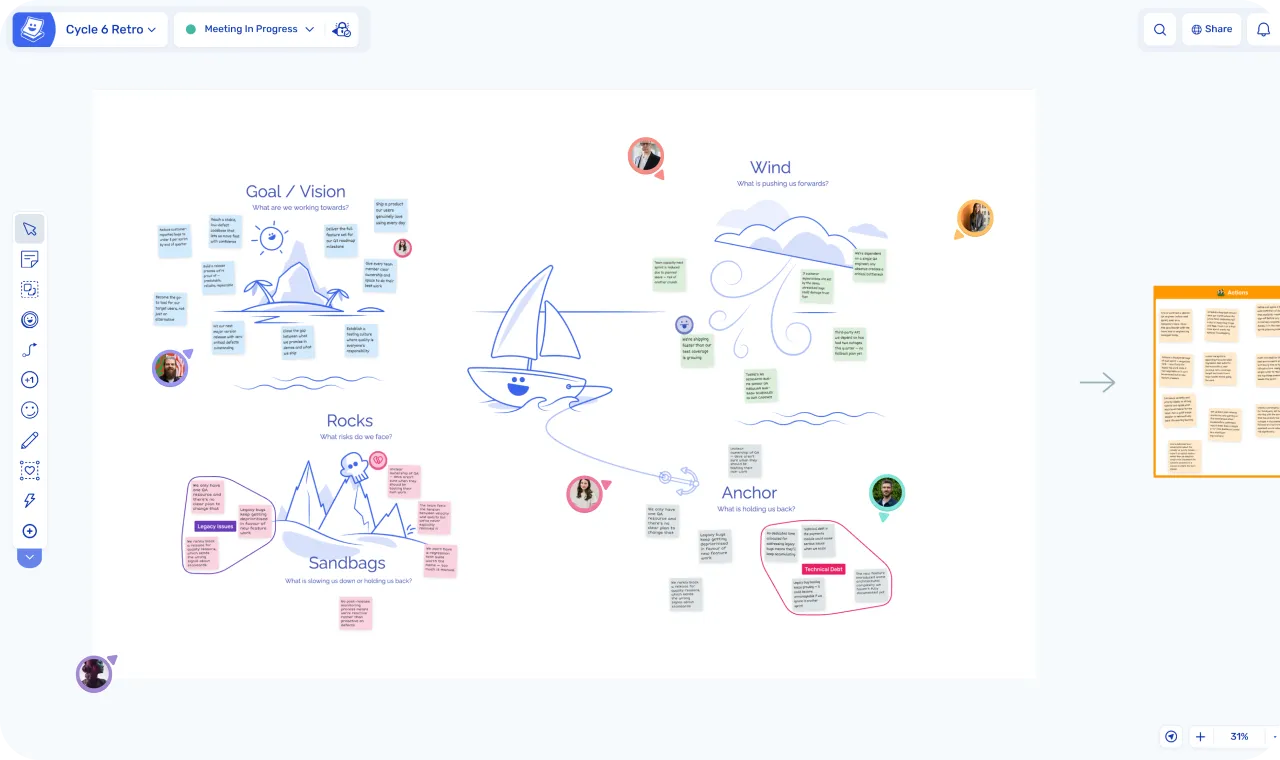
- A Sailboat retro that looks like an actual sailboat scene (anchors below the boat, wind in the sails, rocks ahead)
- A team values exercise built around a hand-drawn diagram
- A workshop with multiple activity frames the facilitator moves the group through
- A spatial grouping exercise using the Topics tool
- A brainstorm with images, drawings, and freeform sticky placement
Every board can look different. Backgrounds, custom shapes, images, drawings, your team’s own templates — the format is limited only by what the session needs. That’s what teams miss when they move to a form-based tool, even one that’s added drawings.
”Almost all solutions I’ve reviewed, they are more like a Kanban. You add tickets, goes straight into a fix column. Creative boards? Can’t. It’s just columns with +/- basically. Doing a retro in a kanban feels like jail to me.”
— Florent, Agile Coach (reviewed 10+ retro tools before choosing Ludi)
Engagement Isn't Decoration
This is where the two tools diverge most visibly.
TeamRetro has Kudos for in-meeting peer recognition, GIFs on retrospective ideas, and emoji on stickies. They’re a thin layer on top of an otherwise functional tool.
Ludi has a jukebox that plays music to the whole board, virtual hats team members can wear during a session, a confetti cannon for celebrating wins, emoji reactions you can stamp on stickies, a spinner for random selection, a buzzer, placeable timers, and icebreaker games, not just icebreaker questions. Each person has a unique handwriting font on their stickies, so contributions feel like they came from different people rather than rows of identical text.
It sounds whimsical. There’s a serious point underneath: remote ceremonies need energy to work. Teams that enjoy a tool show up more engaged and contribute more honestly. The difference between an okay retro and a great one is usually whether people felt comfortable enough to say something they wouldn’t normally say.
”Our engineering team has used Ludi for years. We love it! They’ve thought through all the small things that make a retro fun, as opposed to using a generic whiteboarding application. For us, it’s the small things. Hats, confetti, slaps.”
— Anthony, CTO, Zable Health
One Tool, Every Ceremony
TeamRetro covers retros, health checks, estimation meetings, and maturity model assessments. That’s the scope — all structured agile meetings, none with a freeform canvas underneath.
Ludi covers retros, sprint planning, backlog estimation, team health checks, workshops, brainstorming, story mapping, project kickoffs, root cause analysis, and anything else that fits on a canvas. The same boards your team uses for retros also host your planning sessions and your workshops — one tool, one habit, one shared space.
The Jira integration is the practical wedge. TeamRetro syncs actions to Jira with two-way sync of action titles and completion status. Ludi has full two-way Jira sync that goes further: pull backlog items onto the canvas, estimate collaboratively, break stories down into sub-tasks visually, create new issues from stickies, and sync everything back. It turns the same board into your retro space, your refinement space, and your planning space.
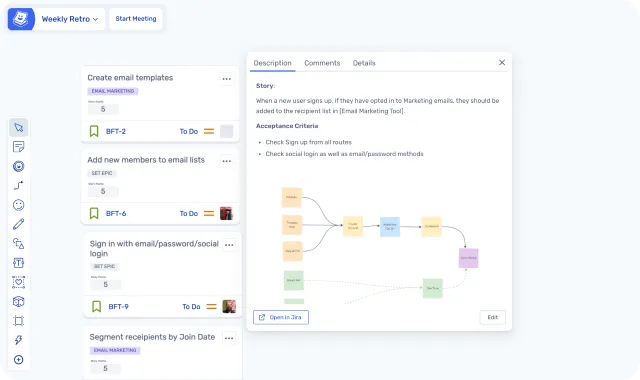
”I run retrospectives and interactive training sessions but also use Ludi to analyse root causes, structure meetings with Lean Coffee, use sprint planning poker for estimation, or just for a brainstorming session.”
— Veronica Onu, Agile Coach, Minsait
Templates: Designed vs Defined
TeamRetro has 200+ templates across retros, health checks, estimation, and maturity models. Ludi has 125+. The numbers aren’t the story.
In TeamRetro, a template defines the structure of your meeting — columns, prompts, voting phase. Customisation means changing a column title or picking a different preset.
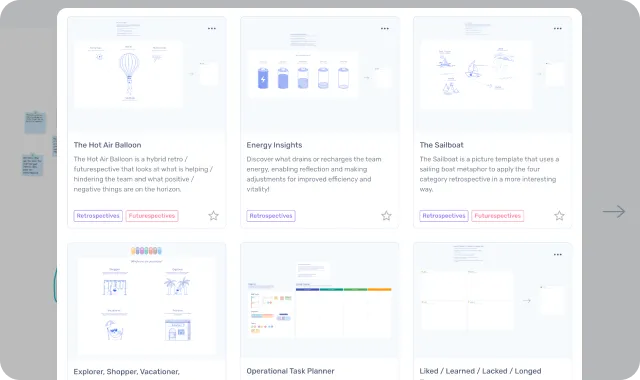
In Ludi, a template is a designed visual activity. A Sailboat retro is a sailboat. A 4Ls retro is four quadrants laid out spatially. Every template is a starting point you can rearrange, combine with others, or build on. The same board can hold two templates side by side, or none at all.
Health Checks and Maturity Models
TeamRetro has 14 prebuilt health check models and 21 maturity model assessments with longitudinal trend tracking. This is a genuine strength — particularly for agile coaches running transformation programmes who need data on team capability over time.
Ludi has health check templates that run on the canvas with the same voting, anonymous contributions, and discussion tools as a retro. What it doesn’t have is the depth of structured analytics or maturity assessments. If longitudinal health data and capability scoring is a real part of your practice, TeamRetro has more depth here.
AI and MCP
TeamRetro has invested heavily in AI across the retro workflow — 9+ AI features spanning template generation, icebreaker generation, suggested grouping, suggested actions, meeting summaries, suggested titles, AI Insights (sentiment and theme analysis with trend tracking), and AI usage reporting. All AI features are included in every paid plan. TeamRetro supports MCP (early access).
Ludi has AI-assisted sticky grouping. It handles the most common use case — sorting contributions into themes — and stays out of your way for everything else. MCP support is coming soon.
Pricing in Practice — Three Teams of 10
Here’s what it costs to run three agile teams of 10 people:
| Ludi Starter | Ludi Business | TeamRetro Small Org | |
|---|---|---|---|
| Pricing model | $4/seat/month | $6/seat/month | $50/month base (3 teams included) |
| Cost for 30 people / 3 teams | $120/month | $180/month | $50/month |
| Annual cost (billed annually) | $1,440 | $2,160 | $600 |
| What you get | Full canvas, 125+ templates, all ceremonies, engagement features, sprint poker | Everything in Starter + two-way Jira, SSO, guest collaborators | Structured retros, health checks, estimation meetings, embedded whiteboards, AI features, MCP (early access) |
TeamRetro is cheaper. The gap on Starter is $840/year — about $70/month, or roughly $5.83 per session if each team runs a weekly retro (≈144 retros/year across three teams). On Business, it’s $1,560/year — about $130/month for the additional Jira sync, SSO, and guest access.
That’s the trade-off in concrete terms. For some teams the saving is the right call. For teams that also need sprint planning, workshops, or anything beyond retros, you’d typically pay that gap (and more) for a second tool. Ludi covers all of it on the same plan.
Who Is Each Tool Best For?
Who Ludi is best for
- Teams that run more than core ceremonies — sprint planning, estimation, workshops, and brainstorming in one tool
- Facilitators who want canvas freedom — design boards your team recognises, not generic columns
- Teams that care about engagement — hats, confetti, music, reactions, and the small things that make remote sessions feel collaborative
- Teams using Jira for planning — two-way sync for refinement, estimation, and sprint planning
- Scrum Masters and coaches running varied ceremonies — retros one week, a kickoff workshop the next, planning the week after
Who TeamRetro is best for
- Pure retro, estimation, health check use case — teams that only ever run structured agile meetings and want straightforward per-team pricing
- Agile coaches running transformation programmes — maturity models and longitudinal health analytics
- Teams that want comprehensive AI throughout the retro flow — TR has more AI features and ships MCP support today
- Organisations requiring SOC 2 Type 2 certification as a hard procurement requirement
What Customers Say
Bernhard Unger-Weber, Scrum Master, ryd
“Ludi has created an obvious uptick in active participation, and shifted the tone of our retrospectives. Team members are now more proactive about suggesting improvements and celebrating wins openly.”
Tim Gaye, Senior Software Engineering Manager, Kaluza
“With Ludi, it’s sort of taking the tool out of the equation and you can actually focus on having a retro. Previously I felt like half the time we were talking about the actual tool.”
Final Verdict
TeamRetro is a competent structured agile meeting tool. If your team only ever runs retros, health checks, and estimation meetings — and the lowest possible cost is the deciding factor — it does the job, particularly for organisations where per-team pricing scales in your favour. They’re also ahead on AI features today, with MCP support in early access.
Ludi is a different category of tool: a real whiteboard your team can shape, with the engagement layer that makes remote sessions worth showing up for, and the breadth to cover sprint planning, estimation, workshops, and brainstorming in the same tool as your retros.
If your team runs varied ceremonies, cares about meeting energy, or wants the option to do more than retros on the same platform, the value case for Ludi is straightforward. If your team will only ever run straightforward retros, TeamRetro has the better case.
Start a free trial — no credit card, no commitment. Pick a template, invite your team, and run your next ceremony in under 5 minutes. Plans start at $4/team member/month.
Start your free 30-day trial — no credit card, no commitment
Frequently asked questions
Last updated: June 2026. Pricing and features verified against teamretro.com/plans and ludi.co.