


If you’re looking for Easter retrospective ideas, here are seven themed formats for you to nibble on. Each one has a different angle, a template to use, and facilitation instructions.
Themed retros work well when the metaphor gives people a fresh angle on problems they’ve been staring at for weeks, and the lighter tone makes it easier to raise the awkward stuff. And it just so happens that Easter is one of the easiest themes to pull off.
If you want to jump straight in, Ludi’s Easter Retrospective template is ready to go. Create the board, share the link, and your team will be adding sticky notes in under a minute.
7 Easter retro ideas
1. The Easter retro (Ludi’s Easter Retrospective)
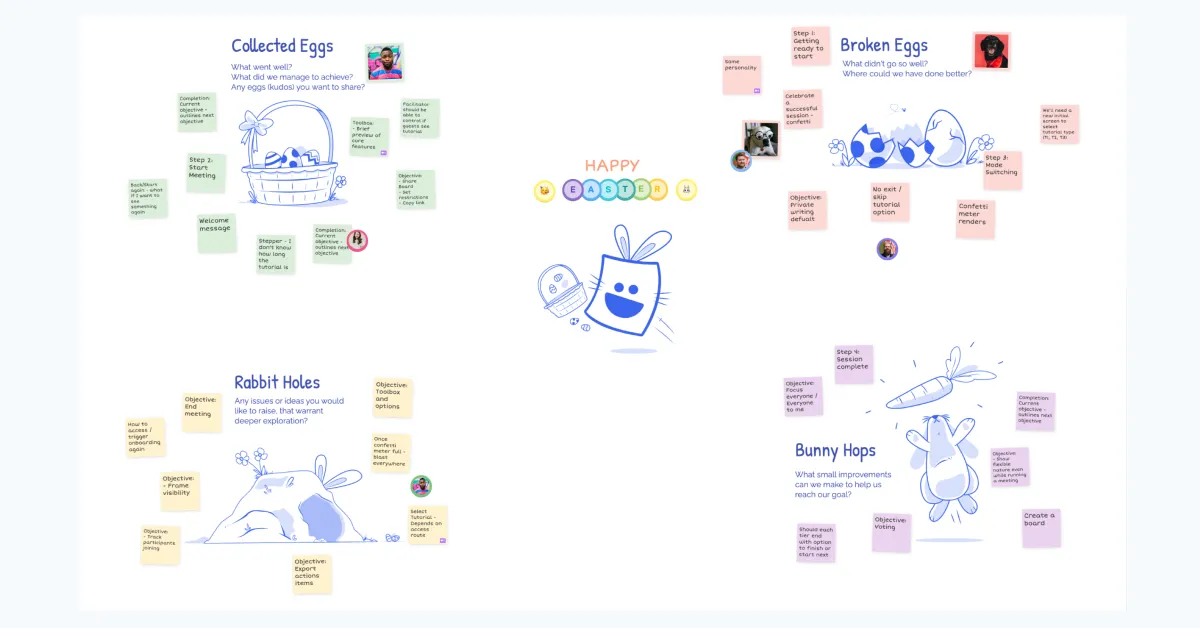
This is Ludi’s Easter Retrospective template, a four-quadrant Easter retro that covers what went well, what went wrong, what needs deeper investigation, and what achievable improvements to make next. There’s also a bonus interactive egg hunt icebreaker included in the board.
 Easter Retro Prompts:
- Eggs Collected (successes and achievements worth celebrating)
- Broken Eggs (challenges, failures, and things that didn’t land)
- Rabbit Holes (topics that need deeper exploration before the team can act)
- Bunny Hops (small, actionable improvements to try next sprint)
How to run it:
- First, have everyone pick an Easter-themed hat for their avatar. There’s bunny ears, a chicken, and more to choose from.
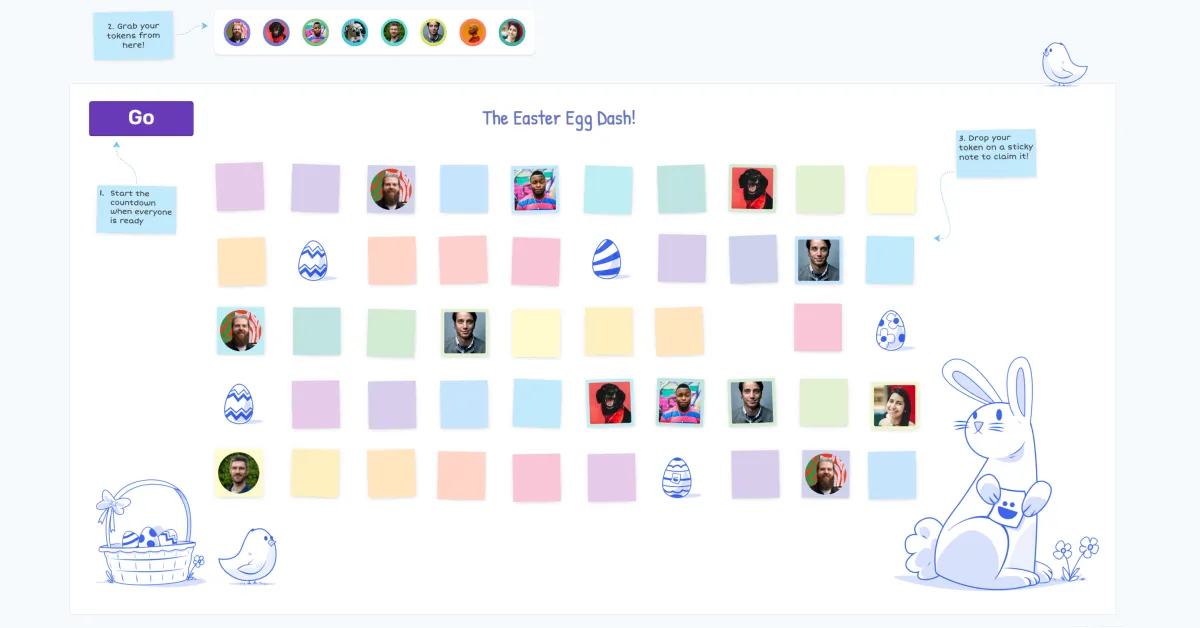
- Start with the Egg Dash icebreaker (5-10 minutes). Team members race to claim sticky notes hiding Easter eggs underneath. It’s fast, competitive, and gets the energy up before the serious discussion starts. No one’s going to be working in a different tab.
- Switch to the retro. Set a ten-minute timer for private writing. Each person adds stickies to Eggs Collected, Broken Eggs, and Rabbit Holes. Keep Bunny Hops empty for now.
- Reveal and discuss (15-20 minutes). Walk through each quadrant, letting people explain their notes. Look for patterns, especially in Broken Eggs and Rabbit Holes.
- Based on the discussion, ask the team to add Bunny Hops: small improvements that address the issues raised. Aim for three to five concrete actions, not a long list.
- Assign owners using the Convert to Action feature and track actions in the team dashboard. These carry forward to your next retro for review.
Best for: Any team looking for a well-rounded Easter retro with a built-in icebreaker. The Rabbit Holes prompt is particularly useful for teams that tend to surface problems without investigating them properly.
Time needed: 45-60 minutes (including icebreaker)
2. The Easter Basket retro — what to keep, what to leave behind
Your team is filling an Easter basket. What goes in? What gets left behind? What do you wish someone had given you?
Prompts:
- Keep in the Basket (practices, habits, or tools worth carrying forward)
- Leave Behind (things to stop doing)
- Wish We Had (things you needed but didn’t have)
- Share with Others (learnings worth passing to other teams)
Five minutes of private writing across all four prompts, then reveal and group. The “Share with Others” prompt often gets overlooked, so give it deliberate attention. If your team has genuinely useful learnings, consider actually forwarding them.
Vote on the top items in “Leave Behind” and “Wish We Had,” as these are where your actions will come from. The “Leave Behind” actions should be things you’ll actively stop, not vague intentions. Two to three actions is plenty.
This one is for teams that struggle to let go. Some teams keep doing things out of habit long after the reason disappeared. The “Leave Behind” prompt forces a direct conversation about what to drop.
Ludi tip: Start with the Open The Box template, rename the titles to match the Easter Basket prompts, and drop in themed images from the icon library or your own images. Five minutes of setup, done.
Time: 45 minutes
3. The Easter Bunny Delivery retro — a familiar format with Easter framing
The Easter Bunny tried to deliver this sprint. What arrived safely? What got lost on the route? What’s still being wrapped up?
Prompts:
- Delivered (wins and completed work)
- Lost in Transit (things that fell through the cracks)
- Still Wrapping (work in progress that carried over)
- Next Delivery (what we need for the next sprint)
This is basically a classic “went well, didn’t go well, next steps” retro with an Easter skin. That makes it a good choice if your team hasn’t done a themed retro before. The structure is familiar, so people can focus on the content rather than figuring out the format.
Run it the same way you’d run a standard retro: private writing, reveal, group, vote, actions. The only difference is the framing, and that’s enough to change how people think about their contributions.
Good for teams trying a themed retro for the first time. Low risk, familiar structure, just enough novelty to feel different.
Ludi tip: Start with the Worked Well / Kinda Worked / Didn’t Work template, rename the sections, and add an Easter Bunny image from the icon library as a centrepiece.
Time: 30-45 minutes
4. The Chocolate Box retro — surfaces empty promises and follow-through problems
A sprint is like a box of chocolates. Some you love, some you’d swap, some have a surprise centre, and some are just an empty wrapper.
Prompts:
- Favourites (things we want to keep doing)
- Would Swap (things we’d change if we could)
- Surprise Centre (unexpected outcomes, good or bad)
- Empty Wrappers (things that looked promising but had nothing inside)
Private writing for five minutes, then reveal. Pay special attention to “Empty Wrappers” as these are often the most actionable items. They’re the meetings that achieved nothing, the processes that look busy but produce no output, the commitments that sounded good but never materialised. Group and vote. Actions should focus on either fixing or removing the Empty Wrappers.
This format works well for teams with a follow-through problem. The “Empty Wrappers” prompt specifically targets things that didn’t deliver on what they promised.
Ludi tip: Start with the Liked / Learned / Lacked / Longed For template. The four-zone layout maps perfectly. Rename the sections, add a chocolate box image or two, and you’re set.
Time: 45 minutes
5. The Easter Egg Decorating retro — improving existing processes
Plain eggs need decorating. Your processes are the eggs. Which ones are beautifully decorated (working well)? Which are half-painted (need more work)? Which are cracked (broken)?
Prompts:
- Beautifully Decorated (polished, working processes)
- Half-Painted (partially working, needs attention)
- Cracked (broken, fix urgently)
- Blank Egg (brand new ideas to try)
This format naturally encourages a balanced view because the first prompt asks for positives. Teams that default to complaints will find themselves acknowledging what’s actually working before they get to the problems.
Focus discussion on the “Half-Painted” items. These are your best-value improvements, things that are already partly working but need more attention or refinement. Two to three actions, prioritising Half-Painted and Cracked.
Good for teams focused on improving what they’ve already got, rather than starting new things.
Ludi tip: Start with the KALM (Keep / Add / Less / More) template, rename the zones, and add Easter egg images from the icon library. Since Ludi’s a whiteboard, you could also lay this out as a grid of four eggs rather than the standard four-zone layout.
Time: 45 minutes
6. The Spring Clean retro — clear out process debt
Clear out what’s not working, organise what is, make room for something new.
Prompts:
- Declutter (stop doing)
- Organise (do better)
- Deep Clean (fix properly, not just a quick patch)
- Make Room (start doing)
How to run it:
Start with a one-minute “clutter audit” icebreaker. Each person names one thing they’d throw out if they could, no discussion, just a quick round. This primes the team for the Declutter section and gets the energy right.
Then run the standard flow: private writing, reveal, group, vote. The “Deep Clean” section is the one to watch here. It’s for problems that keep getting quick fixes instead of proper solutions. Every team has at least one of these: the flaky test suite that gets rerun instead of fixed, the deployment process that needs a restart every third time, the handover document that nobody updates.
Ludi tip: Start with the Drop / Add / Keep / Improve template and rename the sections. Or build it from scratch on a blank board — add four zones, label them, and drag in a broom or dustpan from the icon library for the spring clean vibe.
This one’s for teams drowning in process debt. If you’ve accumulated too many ceremonies, tools, or half-maintained processes, this format gives the team explicit permission to throw things out.
Time: 45-60 minutes
7. The Hot Cross Buns retro — accept constraints, focus energy
What’s hot, what’s crossed, what’s rising, and what’s baked in?
Prompts:
- Hot (wins, things going well right now)
- Crossed (frustrations, things that annoyed the team)
- Rising (improvements in progress, things getting better)
- Baked In (constraints the team can’t change and needs to accept)
How to run it:
The differentiator here is the “Baked In” prompt. Most retro formats assume everything is changeable. In reality, some constraints are fixed: budget limits, platform decisions already made, team size, organisational policies. Teams waste energy railing against things they can’t influence.
The “Baked In” prompt gives the team a place to name those constraints out loud and stop fighting them. Once something is explicitly labelled as a constraint rather than a problem to solve, the team can redirect energy toward things they can actually change.
Run the standard flow, but spend extra time discussing the boundary between “Crossed” and “Baked In.” Sometimes what feels immovable isn’t, and sometimes what feels fixable genuinely isn’t. That’s a useful conversation.
Ludi tip: The Good / Bad / Start / Stop template has a four-zone layout that maps cleanly. Rename the zones to Hot, Crossed, Rising, and Baked In, add a hot cross bun from the icon library, and you’re ready to go.
This one works well for teams that keep circling the same complaints. If the same frustrations come up every retro and nothing changes because they can’t be changed, the “Baked In” prompt lets the team acknowledge that and move on.
Time: 45-60 minutes
How to facilitate an Easter retro that actually produces results
A themed retro only works if it still produces genuine outcomes. The format is different, but the goal isn’t. Here’s how to keep it on track.
Prepare the board in advance. Don’t spend the first ten minutes of your retro setting up the board and explaining the format. Have the board ready before the meeting starts. If you’re using Ludi, the Easter Retrospective template has the structure already set up with zones and auto-colouring so you can just share the link and go.
Use private writing. This matters even more with themed retros. The novelty of the format can amplify the “loudest voice” problem if people start calling out ideas before everyone has had a chance to think. Five minutes of silent, private writing first. Then reveal all at once.
Timebox everything. A themed retro can easily run over because people enjoy the format and spend too long in the fun part. Stick to timings: five minutes for writing, five for grouping, ten for discussion, five for voting, five for actions. That’s 30 minutes for the core retro.
Still assign actions. This is where themed retros most commonly fall down. The energy is good, the discussion is lively, and then everyone leaves without clear next steps. Every retro needs to end with two to three actions that have a named owner and a due date. Track retro actions automatically so they carry forward into your next meeting for review. Google’s research on team effectiveness found that follow-through on commitments is one of the strongest predictors of high-performing teams.
Easter icebreakers to pair with your retro
A quick icebreaker before the retro loosens people up and sets the tone. Keep it to five minutes maximum. If you’re using the Eggs Collected retro (format #1 above), the Egg Dash icebreaker is already built in. For the other six formats, try one of these:
“What’s in your Easter basket?” Each person names one thing they’d put in an ideal Easter basket for the team. Could be a tool, a process change, a snack, anything. It’s light, fast, and primes the team for the retro discussion.
“Easter Egg Emoji Vote” Put a row of spring-themed emojis on the board (sunshine, rain cloud, hatching egg, flowers, chocolate bar). Each person votes on the one that best represents their current mood. No explanation needed, just a quick visual check-in.
“Two Truths and a Lie: Easter Edition” Each person shares three statements about their Easter or spring plans. Two are true, one is a lie. The team guesses. Classic format, seasonal twist. Works well for teams that don’t see each other outside of work. Use the Ludi template: Two Truths and a Lie.
For more warm-up ideas, check out our icebreaker ideas for remote teams.
When Easter retros go wrong
Themed retros can miss the mark. Here’s what to watch for.
Forced fun. If you announce “We’re doing an Easter retro!” and the team groans, don’t push it. Some teams aren’t into themed formats, and that’s fine. You can always use the prompts from this article without the Easter framing. “Favourites, Would Swap, Surprise Centre” works just as well without calling it a chocolate box.
All theme, no substance. The metaphor is supposed to help people think differently, not replace actual reflection. If the discussion stays surface-level (“haha, chocolate box, nice”), the facilitator needs to push deeper. Ask follow-up questions: “What specifically made that an Empty Wrapper? When did you first notice it wasn’t delivering?” If your retros have gone stale generally, these question techniques can help whether you’re running a themed format or not.
Theme overshadowing serious issues. A lighthearted format can make people hesitant to raise serious problems. They don’t want to be the person who kills the fun. Counter this by explicitly saying at the start: “The format is light, but the issues don’t have to be. If something’s genuinely wrong, this is still the place to raise it.”
Too many themed retros. One per quarter is the right cadence to start with. If every retro has a theme, it stops being special and starts being another thing the facilitator is doing to the team rather than for them.
Try one this sprint
Pick one of these Easter retrospective ideas, set up a board, and tell the team you’re trying something different. If it works, great. If it doesn’t, you’ve learned something about what your team responds to, and you can go back to your usual format next time.
Ludi’s Easter Retrospective template is ready in 30 seconds with zones, voting, and private writing already set up. Start a 30-day free trial, no credit card needed.